The cord and the promise
Why improvement doesn't stick. Every plant runs twice: once on paper, once on the floor.
Why andon cords go silent
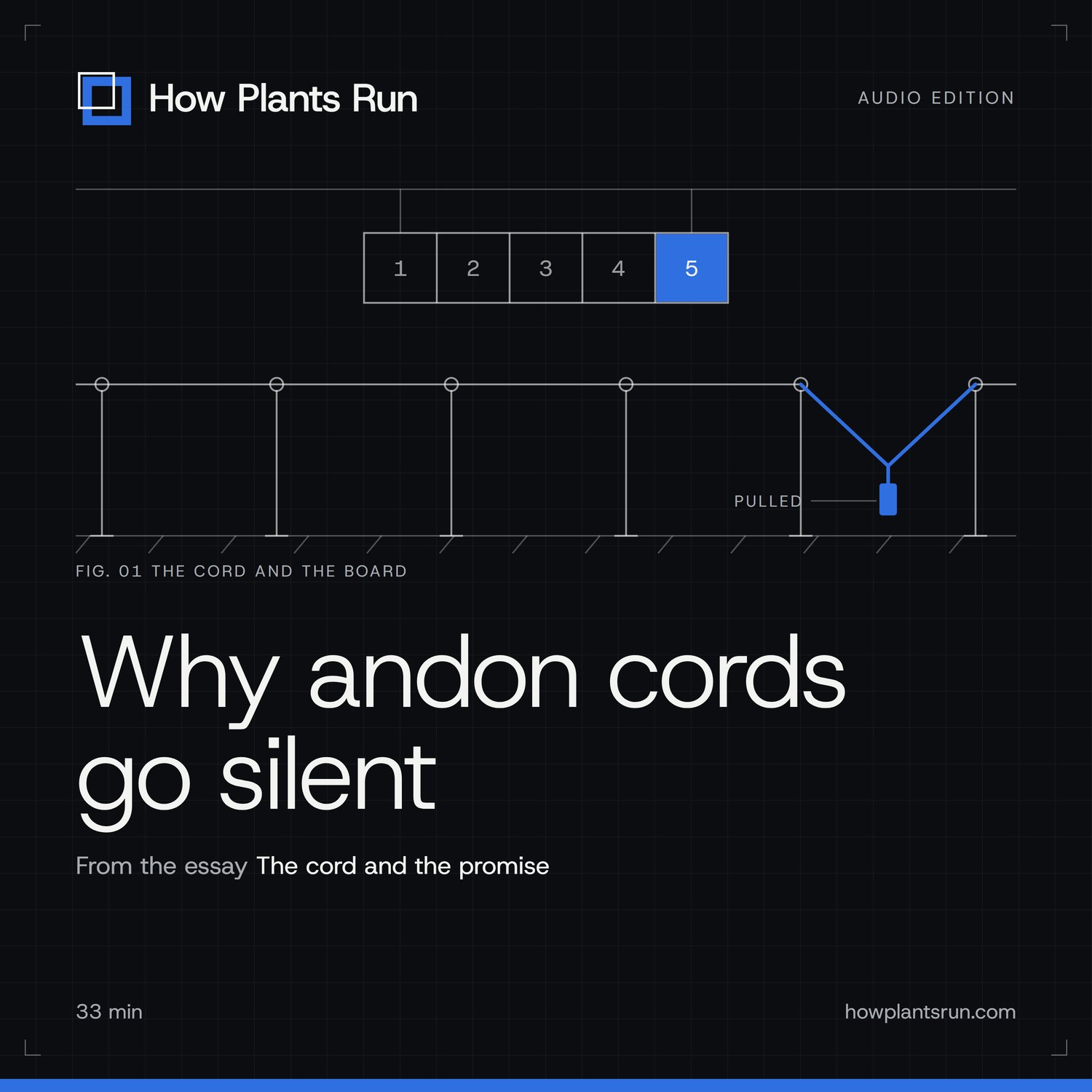
In the years after NUMMI opened, General Motors began hanging andon cords along its assembly lines: ropes, copied from Toyota, that a worker pulls to call for help. This American Life reported in 2010 what happened next: “In some of the factories where they installed the andon cord, workers got yelled at when they pulled it. A few plants even cut the cords down” [1].
NUMMI was the plant GM and Toyota reopened together in 1984 in Fremont, California, with most of the old GM workforce [1]. Within a year its quality went from GM’s worst to GM’s best, writes John Shook, who helped Toyota train its people [2]. A GM vice president, recalled Jeffrey Liker of the University of Michigan, ordered a manager to photograph every square inch of NUMMI and copy it. Good relations between union and management, Liker said, are not “something you can copy, and you can’t even take a photograph of it” [1].
The paper
The first pull does not stop the line; it calls the team leader, who usually fixes the problem while production keeps moving [1][2]. When GM colleagues asked whether workers would get the right to stop the line, Toyota answered: “No, we intend to give them the obligation to stop whenever they find a problem.” In return, management promised: “your team leader will come to your aid within your job cycle,” about a minute [2]. Steven Spear and Kent Bowen, after studying more than 40 plants, made it a rule: every connection between people needs “an unambiguous yes-or-no way to send requests and receive responses” [3].
The channel
GM’s floor had an older rule. “You saw a problem, you stop that line, you were fired,” Bruce Lee of the United Auto Workers told the program [1]. Hung over that rule, the cord said something else.
We read a cord the way we read a shift meeting or an audit sheet: as a channel, which carries what people believe is safe to send. In 1995, at a Big Three plant outside Detroit, Shook watched a worker attach the wrong part. No rope, no team leader nearby; only a red button about 30 paces away that would stop the whole line and bring a supervisor whose help “he probably wouldn’t like.” So “he did nothing” [2].
The distance
Today the pattern has a name. In layered process audits, it is called pencil whipping: filling in the check without doing it [4]. On the Elsmar Cove forum, quality people have posted the warning signs: “If your layered audits are always compliant 100% the audit is doing you no good anymore” [5]. “It’s no good if the 1st layer group leader finds none, 2nd layer supervisor finds 10, and 3rd layer quality finds 50. Should be the other way around” [6]. Ease, which sells audit software, reports that in more than 2.3 million audits by its customers, 84 percent of frontline audits found nothing, while nearly half of upper-management audits found at least one problem. It reads this as pencil whipping [7].
Michael Ballé, a consultant who writes for the Lean Enterprise Institute, joined the two stories in 2014: an andon cord in place “doesn’t do any good if people are reluctant to pull it for fear that it will reveal problems (it would get a good mark on the audit sheet though)” [8].
The channel fails on the way down too. In a 2021 survey commissioned by Microsoft, which sells software to frontline teams, 63 percent of 9,600 frontline workers in eight countries said messages from leadership don’t make it to them. In the US it was 55 percent; in manufacturing, 62 percent [9]. The survey measures perception.
The mechanism
Why does a channel go quiet? In more than a dozen case studies, Nelson Repenning and John Sterman of MIT found that under output pressure, people cut time for improvement and maintenance, and capability erodes in ways that are “delayed, gradual, and diffuse” [10]. An auto-company supervisor told them: “You could say, ‘you are making 20% garbage, stop the line and fix the problem,’ and they would say, ‘I can’t hit my pack count without running like crazy.’” People are “naturally reluctant to tell supervisors they can’t meet all their objectives,” so managers see output rise and miss what was cut. The structure, the authors write, “leads even many talented and dedicated managers” into this trap [10]. At GM’s Van Nuys plant, some managers opposed stopping the line because their bonuses depended on the number of cars built [1].
Nicola Bateman tracked 40 improvement activities from a British automotive industry program through the months after each workshop. Some kept improving; others slid back [11][12]. Two enablers she found in the lasting ones concern the channel: a formal route for ideas from the floor, because “telling my supervisor” breaks down when the supervisor is distracted or replaced, and managers who review the measures and ask why when a gain goes missing [12].
What no single source shows
Side by side, these sources describe one thing. The cord, the layered audit and the message from leadership are channels. GM installed the sending end and kept the old answer. Toyota designed the answer first, down to who comes and how fast [2][3]. What gets counted is still the sending end. A forum member responsible for a site’s audits wanted a better metric than completion, which “does not give any indication of the effectiveness” of the audit [6]. From the office, a perfect sheet and a silent channel look the same.
The plants that held on worked on the answer. Asked what they most wanted to take home from training in Japan, NUMMI’s supervisors gave the same reply every time, Shook writes: “The ability to focus on solving problems without pointing fingers.” Back home, they said, “we’re used to the ‘five whos’” [2]. GM did change, slowly; the accounts we read put it at fifteen to twenty years [1][2].
What we don’t know
We know plants, and we are still learning American ones. Zero findings at layer one can mean a process under control or a checklist nobody reads, and none of the sources we read separates the two with data.
We looked for the study behind a figure that circulates, that 70 percent of lean efforts fail, and found none. A 2011 review of five published versions of a wider claim, that 70 percent of change programs fail, found no valid and reliable empirical evidence [13]. Mark Graban, a lean author and consultant who traced the lean version this year, concluded: “It is a definition, and nobody quotes the definition” [14].
Practitioners are asking too. The Association for Manufacturing Excellence holds its 2026 conference under the theme “People first, progress together,” and one of its tracks calls sustainability “perhaps the hardest challenge” [15].
This is what we will ask people who run plants. The last time someone on your floor pulled the cord or wrote a finding at layer one, what happened in the next ten minutes? And how would anyone two levels up know?
Sources
Read between October 8 and 13, 2026. Type in brackets: primary (original study, firsthand account, official document), vendor (data published by a company that sells to this market), secondary (press, review, column, blog).
- This American Life, “403: NUMMI,” aired March 26, 2010, reported by Frank Langfitt. Quotes from the published transcript. https://www.thisamericanlife.org/403/transcript (secondary: radio reporting with on-the-record interviews)
- John Shook, “How NUMMI Changed Its Culture,” The Lean Post, Lean Enterprise Institute, September 30, 2009. https://www.lean.org/the-lean-post/articles/how-nummi-changed-its-culture/ (primary: firsthand account; the author worked for Toyota on NUMMI’s training)
- Steven J. Spear and H. Kent Bowen, “Decoding the DNA of the Toyota Production System,” Harvard Business Review, September-October 1999. https://hbr.org/1999/09/decoding-the-dna-of-the-toyota-production-system (primary: four-year field study of more than 40 plants)
- Elsmar Cove forum, “Having faith in your Layered Process Auditors - Pencil whipping audits,” posts of May 6 to 8, 2009. https://elsmar.com/elsmarqualityforum/threads/having-faith-in-your-layered-process-auditors-pencil-whipping-audits.33974/ (primary: practitioner accounts, anonymous)
- Elsmar Cove forum, “What is a Layered Process Audit (LPA)?,” post of March 29, 2005, relaying a quality leader. https://elsmar.com/elsmarqualityforum/threads/what-is-a-layered-process-audit-lpa.11170/post-104100 (primary: practitioner account, anonymous)
- Elsmar Cove forum, “Consolidating results of LPA for Management Review,” posts of September 6, 2011, and February 1, 2012. https://elsmar.com/elsmarqualityforum/threads/consolidating-results-of-lpa-layered-process-audit-for-management-review.50144/ (primary: practitioner accounts, anonymous)
- Ease, “Layered Process Audit Benchmark” report summary, May 6, 2026. https://www.ease.io/blog/layered-process-audit-benchmark-survey/ (vendor: Ease sells layered audit software; data from its own customers)
- Michael Ballé, “Dear Gemba Coach” column on lean maturity audits, The Lean Post, Lean Enterprise Institute, March 27, 2014. https://www.lean.org/the-lean-post/articles/were-being-audited-on-five-levels-on-fifteen-topics-i-feel-that-if-we-actually-worked-on-all-these-items-the-plant-would-just-stop-working-am-i-missing-anything/ (secondary: consultant’s column)
- Microsoft, Work Trend Index special report on frontline workers, January 12, 2022. Survey by Edelman Data x Intelligence of 9,600 frontline workers in eight industries and eight countries, October 28 to November 19, 2021. Report: https://www.microsoft.com/en-us/worklab/work-trend-index/technology-unlocks-a-new-future-for-frontline ; country and industry figures in the appendix of the full PDF: https://assets-c4akfrf5b4d3f4b7.z01.azurefd.net/assets/2023/09/af85c604-f623-432d-b0cf-8b4eea87790a-WTI_FrontlineWorkers.pdf (vendor: Microsoft sells software to frontline teams)
- Nelson P. Repenning and John D. Sterman, “Nobody Ever Gets Credit for Fixing Problems that Never Happened: Creating and Sustaining Process Improvement,” California Management Review 43(4), 2001, pp. 64-88. https://doi.org/10.2307/41166101 ; author copy: https://web.mit.edu/nelsonr/www/Repenning=Sterman_CMR_su01_.pdf (primary: field studies and models)
- Nicola Bateman, “Sustainability: the elusive element of process improvement,” International Journal of Operations & Production Management 25(3), 2005, pp. 261-276. https://doi.org/10.1108/01443570510581862 (primary: study of 40 improvement activities)
- Nicola Bateman, with SMMT Industry Forum, “Sustainability,” practitioner guide, Lean Enterprise Research Centre, Cardiff Business School, 2001. https://industryforum.co.uk/wp-content/uploads/sites/6/2015/07/Sustainability.pdf (primary: research report for practitioners, same study)
- Mark Hughes, “Do 70 Per Cent of All Organizational Change Initiatives Really Fail?,” Journal of Change Management 11(4), 2011, pp. 451-464. https://doi.org/10.1080/14697017.2011.630506 (secondary: review of five published sources)
- Mark Graban, “Do 90% of Lean Transformations Really Fail? I Went Looking for the Number,” Lean Blog, July 30, 2026, updated October 7, 2026. https://www.leanblog.org/2026/07/lean-transformation-failure-rate-90-percent/ (secondary: blog of a lean author and consultant)
- Association for Manufacturing Excellence, AME Milwaukee 2026 International Conference, theme and tracks. https://www.ame.org/conference/ame-milwaukee-2026-international-conference (primary: official page)
How Plants Run · The people who run American plants, on the record.
The audio edition of this piece is AI-narrated.
Run part of a plant? Be in a conversation.
Be a guest, opens a short form